
Updated October 2026 · Reviewed by Raquel Carmona Flaquer, lawyer (ICAFI no. 829)
Foreigners can buy property in Spain on exactly the same terms as Spanish citizens. What changes the outcome is not your nationality but what you check, sign and budget before the notary. This guide walks you through the whole process, the real costs, the taxes you will owe every year, and what buying does (and no longer does) for your right to live here.
- No residency is needed to buy. You only need an NIE (número de identidad de extranjero, foreigner identity number).
- The document that really binds you is the deposit contract (contrato de arras), signed weeks before the notary.
- Budget roughly 6% to 15% on top of the price, depending on the region and on whether the home is new or resale.
- Buying a home no longer gives residency: the Golden Visa for property investors ended on 3 April 2025.
- Non-resident owners pay Spanish tax on the property every year, even if it is never rented out.
Can foreigners buy property in Spain?
Yes. EU and non-EU citizens alike can buy homes, land and commercial property in Spain, in their own name or through a company. There is no general requirement to live here or to hold a visa. Some limits do exist: certain military or border areas need prior authorisation, and some regions are debating restrictions on homes that will not be used as a main residence (see the Catalonia section below).
In practice, the risk for a foreign buyer is not legal access but information asymmetry. The estate agent is paid by the seller, and the notary confirms that the deed is valid, not that the purchase is a good one for you. That gap is what an independent lawyer fills.
The buying process, step by step
- Get your NIE and a Spanish bank accountThe NIE is required to sign, pay taxes and register the property. It can be requested at a Spanish consulate or in Spain, or by your lawyer with a power of attorney.
- Run a red-flag review before you offerOrder the nota simple (Land Registry extract) and compare it with the cadastre. Undeclared extensions, debts, embargoes or a boundary mismatch usually show up here. Read our guide to real estate pitfalls in Spain.
- Sign a deposit contract that protects youThe contrato de arras usually involves a deposit of around 10% of the price. With arras penitenciales, a buyer who withdraws normally loses it and a seller who withdraws returns it doubled. Exit clauses for failed checks or a refused mortgage only exist if they are written in.
- Complete full due diligenceLicences, planning rules, community debts, coastal protection zones, tourist-rental licences and the seller’s tax position. It must be finished before the deposit deadline, while you can still walk away.
- Arrange the moneyMortgage approval if needed, and the funds in a Spanish account in time for the bank drafts on completion day.
- Sign the deed at the notaryBuyer and seller (or their attorneys) sign the escritura pública. You can sign in person or through a power of attorney without travelling.
- Pay the taxes and registerTransfer tax is paid within the legal deadline (about one month), then the deed is registered in your name at the Land Registry, and utilities and IBI (impuesto sobre bienes inmuebles, local property tax) are moved to you.
Buying on the Costa Brava?
Our property lawyers in Figueres review your deposit contract, run the due diligence and handle the notary. Fixed fee, quoted within one working day.
How much does it cost to buy a property in Spain?
Beyond the agreed price, the main cost is tax, and it depends on whether the home is resale or new.
| Cost | Resale home | New-build from a developer |
|---|---|---|
| Main tax | ITP (impuesto sobre transmisiones patrimoniales, transfer tax): set by each region, from 4% in the Basque Country up to 13% in Catalonia | 10% VAT (value added tax) on homes |
| Stamp duty | Not charged on top of ITP | AJD (actos jurídicos documentados), set by each region, for example 1.5% in Catalonia |
| Notary and Land Registry | Regulated scales, usually around 1% of the price combined or less | |
| Legal fees | Your lawyer’s fee; at MigratioLex a fixed fee agreed in advance | |
| Mortgage costs | Valuation and gestoría (administrative agency) fees if you finance the purchase | |
Transfer tax in Catalonia
Catalonia applies a progressive scale on resale homes: 10% up to €600,000, 11% from €600,000 to €900,000, 12% from €900,000 to €1,500,000 and 13% above that. Each rate applies only to the part of the price inside its band. Reduced rates exist for some buyers of their main home.
Tax rates change frequently. Always confirm the figure for your purchase before signing the deposit contract.
Can non-residents get a mortgage in Spain?
Yes. Spanish banks lend to non-residents, but usually on stricter terms than to residents: a lower loan-to-value ratio (often around 60% to 70% of the valuation), proof of income in your home country and a Spanish bank account. If the purchase depends on the mortgage, the deposit contract should say so, so that you can recover the deposit if the loan is refused.
Taxes you pay every year as an owner
| Tax | Who pays | How it works |
|---|---|---|
| IBI (local property tax) | Every owner | Annual, set by the town hall on the cadastral value |
| Non-resident income tax on an empty home | Non-residents who do not rent it out | Declared on Modelo 210 on an imputed income of 1.1% or 2% of the cadastral value, taxed at 19% (EU and EEA residents) or 24% (everyone else) |
| Non-resident tax on rental income | Non-residents who let the property | Also on Modelo 210: 19% on net income for EU and EEA residents, who can deduct expenses; 24% on gross income for everyone else |
| Wealth tax | Owners with high net assets in Spain | Depends on the region and the value of the estate |
Read the full breakdown in our guide to non-resident property tax in Spain. If you plan to move here, check first whether you would become a Spanish tax resident with our free residency test.
Selling a property in Spain as a non-resident
When the seller is not tax-resident in Spain, the buyer must withhold 3% of the price and pay it to the Tax Agency within one month (Modelo 211). The seller then declares the capital gain on Modelo 210, taxed at 19% for non-residents, and can reclaim any excess retention. The town hall also charges the plusvalía municipal (local land value tax). Preparing these figures before the property goes on the market avoids surprises once an offer arrives.
Renting out your property
Long-term rentals
Residential leases are governed by the LAU (Ley de Arrendamientos Urbanos, Urban Leases Act). Tenants can extend the contract up to 5 years when the landlord is an individual, or 7 years when it is a company, and annual rent increases are capped. In areas declared stressed housing markets, additional rent controls can apply.
Holiday and tourist rentals
Tourist rentals are regulated by each region and, increasingly, by each town hall. In Catalonia a tourist-use licence must be registered, and many municipalities now restrict new ones. If rental income is part of your plan, confirm that a valid licence exists, and that it can continue under your ownership, before you sign anything.
The Catalan Parliament is debating a law that would allow town halls in stressed housing-market areas to restrict purchases of homes that will not be the buyer’s habitual residence or a long-term rental. It is not in force and its final text is still under negotiation. If you are buying a second home in Catalonia, ask us how it could affect your purchase.
Does buying property give you residency in Spain?
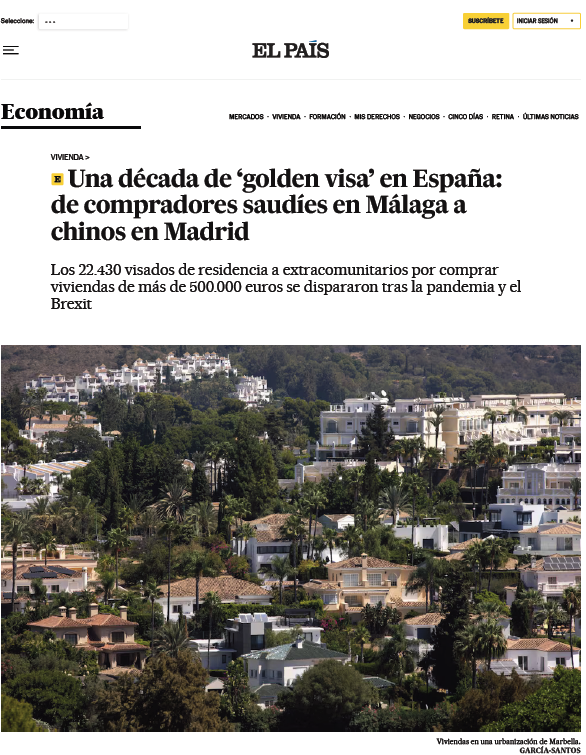
Not any more. Spain’s Golden Visa, which granted residence to non-EU investors buying property worth at least €500,000, stopped accepting new applications on 3 April 2025. MigratioLex was consulted by EL PAÍS for its report on a decade of Golden Visas in Spain: read the EL PAÍS report and our view on it.
Today, owning a home and living in Spain are two separate legal questions. The most common routes for property buyers who want to stay are:
Buying Property in Spain: Guides by Topic
Before you buy


Costs and taxes
Signing and registration
Owning, renting and selling
Frequently asked questions
Can foreigners buy property in Spain?
Yes. Foreigners, from inside or outside the EU, can buy property in Spain on the same terms as Spanish citizens. You only need an NIE (foreigner identity number).
Do I need to live in Spain to buy a home there?
No. Residency is not required to buy. If you want to live in the property, you need a separate visa or residence permit.
Does buying property in Spain still give a Golden Visa?
No. The Golden Visa for property investors stopped accepting new applications on 3 April 2025. The usual alternatives are the Non-Lucrative Visa and the Digital Nomad Visa.
How much are the buying costs in Spain?
Usually between 6% and 15% of the price on top, depending on the region and whether the home is resale (transfer tax) or new (VAT plus stamp duty). In Catalonia, transfer tax on resale homes runs from 10% to 13%.
Can I buy property in Spain without travelling?
Yes. With a power of attorney signed at a Spanish consulate, or before a notary in your country with an apostille, your lawyer can sign the deed for you.
Do I pay tax on a Spanish holiday home I do not rent out?
Yes. Non-resident owners declare an imputed income on Modelo 210 every year, taxed at 19% for EU and EEA residents or 24% for others, plus the local IBI.
Do I need a lawyer to buy property in Spain?
It is not legally required, but nobody else in the transaction works for you. The agent is paid by the seller and the notary checks validity, not whether the deal is good for you.
Talk to a lawyer before you pay a deposit
Send us the property and what you have been asked to sign. We reply within one working day with what we would check and a fixed fee. The quote is free.
Official sources: Real Decreto Legislativo 5/2004 (non-resident income tax), Ley 29/1994 (Urban Leases Act), Ley 3/2017, Book Six of the Catalan Civil Code (article 621-8 on deposits), Decree-law 5/2025 of Catalonia (transfer tax scale), Ley Orgánica 1/2025 (end of the Golden Visa). This guide is general information and not legal advice for your specific case.