One of our clients came to Spain on a Non-Lucrative Visa.
He could live here legally. He could build a life here. He could study the market, look for premises and prepare a business idea.
What he could not do was actually run that business.
For almost a year, he had been developing a project for a specialised garage in Alicante focused on electric vehicles, an area where qualified technical capacity is still much more limited than in the traditional automotive sector.
The business idea was there.
The legal right to operate it was not.
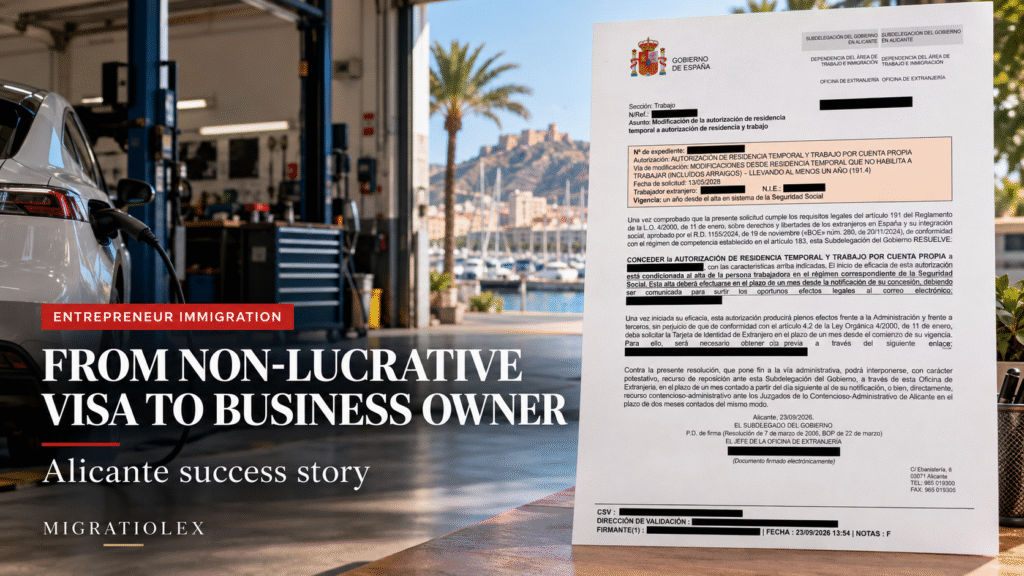
That changed once he became eligible to modify his residence status into a residence and work authorization for self-employment.
Under Article 191.4 of Royal Decree 1155/2024, a person who has been legally resident in Spain for at least one year under a residence authorization that did not allow them to work can, subject to the applicable requirements, modify that status into a residence and work authorization.
For our client, that was the bridge between simply residing in Spain and legally building the business he had been preparing.
Case Snapshot
The Important Part Was Not the Visa He Started With
This case started with a Non-Lucrative Visa, but the broader point is the possibility of changing immigration status once a person’s circumstances and plans in Spain evolve.
A residence permit that made sense when someone first moved to Spain may no longer make sense one or two years later.
Someone may arrive without intending to work in Spain and later identify a business opportunity.
A remote worker may eventually want to move away from the activity on which their original authorization was based and establish a Spanish business.
Another resident may simply want to transition into the ordinary Spanish residence-and-work system.
Those situations need to be analysed according to the specific authorization the person currently holds, because not every residence category works in exactly the same way.
In our client’s case, however, the legal route was clear: after completing the required period of legal residence, he could apply to move from non-working residence into self-employment.
A Business Plan Is Not Just a Description of the Idea
For a modification into self-employment, saying that you have a good business idea is not enough.
The immigration authorities need to understand whether the proposed activity can actually function.
That means showing, among other things:
- what the business will do
- what investment is required
- how the activity will be financed
- necessary qualifications or experience
- licences or authorisations required
- projected costs and revenues
- whether the project is economically credible
For this case, that meant turning the idea of an EV-focused garage into a project that could be assessed on paper by someone who had never met our client and knew nothing about his plans.
We therefore prepared the business project and obtained an independent viability assessment from one of the organisations recognised for this purpose, such as ATA or UPTA.
These reports do not replace the immigration authority’s decision.
They do, however, provide an independent assessment of elements such as the applicant’s professional background, the proposed investment and the viability of the activity. For a self-employment application, that can be an important part of the evidentiary package.
Then Came the Waiting
The official processing period for this type of modification is three months.
If those three months pass without notification of a decision, the application may be understood to have been rejected by administrative silence.
That does not necessarily mean that the Administration will ultimately issue a negative decision.
It means something much more practical: the applicant should not assume that the right to work has been granted merely because the three-month period has expired.
Our client’s application passed that three-month mark.
The file remained pending into a fourth month.
And then the Alicante Immigration Office issued the favourable decision.
The modification had been approved.
There was still one important step before the authorization became effective: registration with the corresponding Social Security regime, which must take place within one month of notification.
Once that condition was completed, our client could finally begin operating the business legally.
The Approval Was Only the First Step
The initial authorization obtained through this modification lasts one year.
During that first year, the authorization remains an initial residence and work authorization for self-employment and is subject to the limitations applicable to that category.
But the position changes significantly at renewal.
Under the current Immigration Regulations, a renewed residence and work authorization for self-employment is valid for four years and allows its holder to work both as an employee and as a self-employed person, anywhere in Spain and in any sector of activity.
That is the part of the process that many applicants overlook.
The immediate objective may be permission to launch one specific business.
But, after the first renewal, the result can be considerably broader: access to the ordinary Spanish labour market both as an employee and as an entrepreneur.
So for our client, the garage was not merely the business project that supported the application.
It was the route through which his immigration status evolved.
That distinction is why choosing the right modification strategy matters.
Immigration status should not only reflect how someone entered Spain.
It should also be able to evolve with what they decide to build once they are here.
Thinking About Building a Business in Spain?
Take our two-minute eligibility check to see where your business idea and your immigration status currently stand.
Check Your Business Eligibility →Planning to Build a Business in Spain?
Whether you are on a Non-Lucrative Visa, a Digital Nomad Visa, or another residence permit without work rights, the path to legally running your own business is usually closer than it looks. MigratioLex advises international entrepreneurs and business owners on Spanish residence, self-employment permits and business-related immigration strategy. We respond within 24 hours, in English, French or Spanish.
Book Your Initial ConsultationCase details have been generalised to protect client confidentiality. This article is for informational purposes only and does not constitute legal advice. It is based on Article 191.4 of Royal Decree 1155/2024 (in force since 20 May 2025), current as of 2026.