You can work from anywhere. Your laptop doesn’t care whether the window looks onto Gran Vía or the Atlantic. Your tax bill does: in Spain, the region you live in changes your income tax scale, your wealth tax and the grants you can claim.
We compared the five regions our self-employed clients ask about most, focusing on cities with an international airport on their doorstep. Every figure below applies to the 2026 tax year. Income tax rates are top combined marginal rates on the general tax base: your real saving depends on your profit and family situation.
Everything below applies to freelancers who are Spanish tax residents: in general, you spend more than 183 days a year in Spain, or your main business or economic interests are here. Non-residents pay tax under different rules.
Not sure where you stand? Take our free Spanish tax residency test →
How Your Region Changes Your Tax Bill
Spain shares tax powers with its autonomous communities. For a freelancer (autónomo), three things depend on the region:
- Income tax (IRPF): half of the scale and dozens of extra deductions are set by each region.
- Wealth tax: each region sets its own allowance and discounts.
- Grants for your economic activity: from refunded Social Security quotas to cash grants for new freelancers.
Your region of residence is mainly the one where you spend the most days of the year. If that cannot be determined, your main centre of interests counts and, failing that, your last residence declared for income tax. The law also sets a specific presumption against some moves made to lower your tax bill.
The Five Regions at a Glance
Madrid
- Wealth tax: 100% discount
- Cuota cero: yes
- Extra: €1,031 if under 35
Andalusia
- Wealth tax: 100% discount
- Cuota cero: by call
- Extra: rent up to €1,200
Canary Islands
- Wealth tax: standard
- Cuota cero: by call
- Extra: IGIC 7% and RIC
Valencia
- Wealth tax: €2M allowance
- Cuota cero: no
- Extra: up to €900 per birth
Catalonia
- Wealth tax: the toughest
- Cuota cero: no
- Extra: youth grant (2026: €17,094)
What You Get Anywhere in Spain
Before comparing regions, know the state rules that apply in every one of them. They often save more than the regional differences.
Social Security
New autónomos pay a reduced quota of €80 a month for 12 months, about €88.64 in 2026 with the intergenerational equity surcharge (MEI). It can be extended a second year if net income stays below the minimum wage.
After that, you contribute on your real net income across 15 brackets, from about €206 to €1,607 a month, depending on the base you choose within your bracket. Official rules: Spanish Social Security.
Business expenses you can deduct
Tax breaks for freelancers
Tax breaks for parents and families
On top of these, each region adds its own deductions. Most have income limits, so high earners often cannot use them.
1. Madrid: The Lowest Top Income Tax Rate of the Five

Best for: high earners, young founders and families
Income tax
Madrid applies the lowest regional scale in Spain (8.5% to 20.5%), so the top combined marginal rate on the general tax base is 45%, versus 50% in Catalonia.
Wealth tax
A 100% discount, calculated against the state Solidarity Tax on Large Fortunes (ITSGF): you pay nothing while your taxable base, after the €700,000 allowance, stays within the ITSGF’s first €3 million band at 0%.
Regional deductions
- Self-employment under 35: a fixed €1,031 in the year you first register as a freelancer, if you keep the activity for at least a year.
- Birth or adoption: €721.70 per child, in the year of birth and the two following years (income limits apply).
- Rent for under-35s: up to €1,237.20 a year, subject to income limits.
Grants for your activity
Madrid’s cuota cero refunds the reduced quota you paid, subject to requirements and the available budget. You must apply within three months after each subsidised period.
Airport and lifestyle
Madrid-Barajas sits inside the city limits, with direct flights worldwide. The trade-off: high rents and no beach.
2. Andalusia (Malaga and Seville): Low Tax With Sun and Sea

Best for: lifestyle without paying Catalan or Valencian taxes
Income tax
The regional scale runs from 9.5% to 22.5%, for a top combined marginal rate on the general tax base of 47%.
Wealth tax
Same mechanism as Madrid: a 100% discount calculated against the ITSGF, so you pay nothing while your taxable base, after the €700,000 allowance, stays within the €3 million band at 0%.
Regional deductions
- Rent: 15%, up to €1,200 a year (€1,500 with a disability) for under-35s, over-65s and other protected groups.
- Birth or adoption: €200 per child, or €400 in municipalities at risk of depopulation, with no income limit since 2026.
- Language and IT classes for children: 15%, up to €150 per child.
- New in 2026: deductions for gym and sports fees and vet bills.
Grants for your activity
Andalusia’s “Tarifa Cero” refunds the reduced quota for 12 months, and can cover a second year if your net income stayed below the minimum wage. The latest call closed on 30 September 2026.
Airport and lifestyle
Malaga (Costa del Sol airport, 15 minutes from the centre) is the remote workers’ favourite, with direct flights to the UK, US and the Gulf. Seville offers lower rents and its own airport next to the city.

3. Canary Islands (Las Palmas and Santa Cruz): Unique Tax Regime

Best for: year-round sun and a strong remote-work community
Income tax
Here the islands are not cheap: the regional scale reaches 26%, a top combined marginal rate on the general tax base of 50.5%.
Indirect tax
The islands apply IGIC, with a standard rate of 7% on taxable transactions. The Canary Islands’ small-business IGIC exemption (REPEP, Special Regime for Small Businesses and Professionals) is available to eligible self-employed individuals established in the islands, regardless of nationality.
The standard threshold for 2026 was €30,000 in turnover in the previous calendar year. A special application window in July 2026 allowed certain individuals with 2025 turnover above €30,000 and up to €50,000 to opt in. From 1 January 2027, the standard threshold rises to €50,000. If you mainly serve businesses outside the Canary Islands, your services will generally fall outside IGIC under the place-of-supply rules.
Wealth tax
No regional discount: the standard €700,000 allowance and state scale apply.
Regional deductions
- Reinvested profits (RIC, Reserve for Investments in the Canary Islands): freelancers in direct assessment can cut the tax on profits from their Canary business that they reinvest in the islands.
- Birth or adoption: €265 for the first or second child, rising to €928 from the fifth.
- Nursery: 18%, up to €530 per child under 3.
- Rent: 24%, up to €740 a year, subject to income limits.
- Moving to another island for work: €300, including to start a business activity.
Grants for your activity
The islands run a cuota cero by call. The 2026 call closed on 15 October 2026, so timing matters.
Airport and lifestyle
Spring-like weather all year and a large remote-worker community. Gran Canaria and Tenerife North airports are close to each capital, but flights to mainland Europe take 3 to 4 hours.
4. Valencian Community (Valencia and Alicante): Generous for Families

Best for: moderate incomes and young families
Income tax
The 2026 regional scale runs from 8.8% to 29.35%, giving a top combined marginal rate on the general tax base of 53.85%, the highest in the common regime.
Wealth tax
For residents, the exempt allowance rises to €2 million from the 2026 tax year.
Regional deductions
- Birth or adoption: €600 for the first child, €750 for the second and €900 from the third, for three years (income limits around €30,000 per person).
- Rent: 20%, up to €800 a year, rising to 30% and €1,100 in some cases.
- Renting to work in another town: 10%, up to €224, if you move more than 50 km to run your activity.
Grants for your activity
There is no general cuota cero. Valencia City Council’s “Primeros Pasos 2026” programme gives direct aid to freelancers who have had or adopted children since 2024. It is limited to the municipality of Valencia, so it does not cover freelancers based in Alicante.
Airport and lifestyle
Beach, city and lower living costs than Madrid or Barcelona, with airports next to both Valencia and Alicante.
5. Catalonia (Barcelona): Big Grants for Young Freelancers

Best for: freelancers who need Barcelona’s network, and under-30 founders
Income tax
Regional rates from 9.5% to 25.5%, a top combined marginal rate on the general tax base of 50%. Lower incomes are less penalised since the 2025 reform.
Wealth tax
The toughest in Spain: a lower €500,000 allowance, no discount and rates up to 3.48%.
Regional deductions
- Birth or adoption: €150 per parent, or €300 in a joint return or for single parents.
- Rent: 10%, up to €500 a year (€1,000 in some cases), only for specific groups such as young or unemployed tenants.
Grants for your activity
No cuota cero, but a major grant for young freelancers: the 2026 call offered €17,094 to people aged 18 to 29 registered as Youth Guarantee beneficiaries the day before starting their activity, who kept the activity and their tax address in Catalonia for 18 months. That call closed on 22 September 2026.
Airport and lifestyle
Barcelona-El Prat is 20 minutes from the centre, and the city has Spain’s strongest international tech and creative scene.
Our Verdict
- Highest earners: Madrid, followed closely by Andalusia, with the lowest top marginal rates and a 100% wealth tax discount coordinated with the state Solidarity Tax.
- Freelancers under 35 in Madrid: €1,031 in the year you register, plus cuota cero.
- Parents with moderate incomes: Valencia and Madrid pay the most per birth, and the state maternity deduction applies everywhere.
- Under-30 founders: Catalonia’s youth grant (€17,094 in the 2026 call) can outweigh its higher taxes in the first years, if a new call opens.
- Canary Islands: great lifestyle, IGIC and RIC advantages, but high income tax.
Your real burden still depends on your profit, your family and your savings. Above a taxable base of €3 million after the €700,000 allowance, the state Solidarity Tax may apply in every region, although the wealth tax actually paid is deducted from it and joint limits can apply.
If You Are Not an EU Citizen
If you do not already hold a permit to work as self-employed in Spain, choosing the city comes second: you first need the right residence permit. For remote freelancers who meet its requirements, one route is the Digital Nomad Visa under Law 14/2013, designed for professionals working for companies based outside Spain, with work for Spanish companies allowed up to 20% of their professional activity. If Spain is your plan, start your Digital Nomad Visa application.

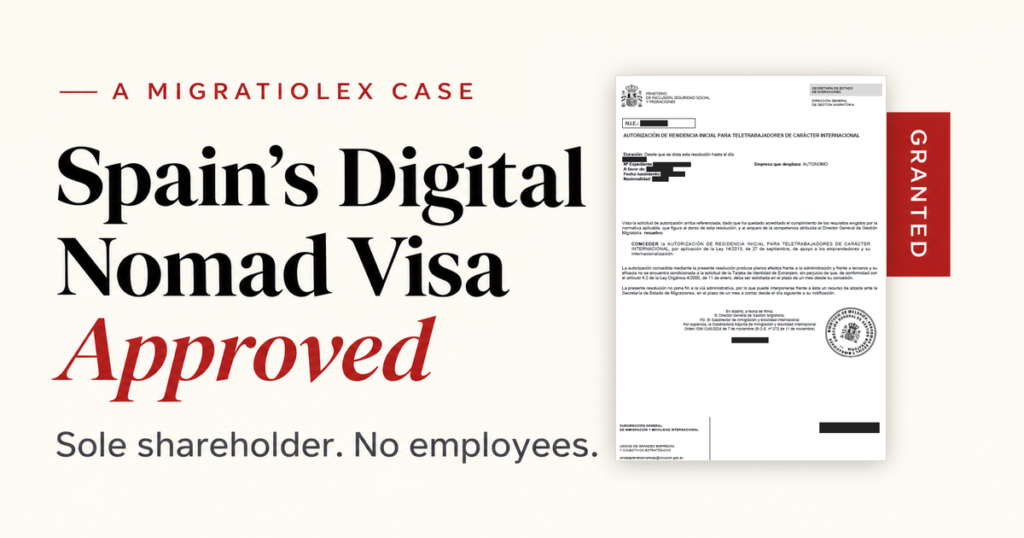
Freelancers with several clients face stricter scrutiny than employees. See how we got a freelance digital nomad approved under the new criteria.
Why This Decision Is Harder Than It Looks
- Registering in one region while living in another: residence follows where you spend most days, and the tax office checks it.
- Moving mainly to save tax: the law presumes that some changes of region made to lower your tax bill are not valid, so the move must be real.
- Assuming the Beckham Law covers you: the special regime generally does not apply to ordinary self-employed income.
- Counting on “cuota cero” before confirming the call is open and that you meet its requirements.
- Looking only at income tax and forgetting wealth tax on savings, investments and property.
- Missing regional deductions: many are not pre-filled in your tax return and have strict income limits.
Know Your Spanish Tax Bill Before You Choose a City
Share your income and situation, and our team will send you a provisional, personalised tax estimate with your next steps.
Get Your Free Tax Estimate →Gran Vía or the Atlantic, your laptop will work the same. The difference is in the numbers behind each view, and they are far easier to get right before you register your new address than after your first tax return.
Talk to Our Legal Team Before You Move
If you are still weighing regions, that doubt is exactly what a consultation is for. Our legal team reviews your residence route and your tax position together, with your real figures. We respond within 24 hours, in English, French or Spanish.
Book Your Initial ConsultationThis article is for informational purposes only and does not constitute legal or tax advice. Based on Law 35/2006 (IRPF), Law 19/1991 (Wealth Tax), Law 22/2009, Law 38/2022 (ITSGF), Law 14/2013 and the 2026 regional tax rules of Madrid, Andalusia, the Canary Islands, the Valencian Community and Catalonia.