You work for yourself and you want to live in Spain. The Digital Nomad Visa vs Autónomo Visa decision is the first fork in the road, and they sound similar, but they are not. Picking the wrong one can cost you months of delay, a refusal, or a legal setup that does not match how you actually work.
Digital Nomad Visa vs Autónomo Visa: Where Your Clients Are
One question decides almost everything else: who pays you. The Digital Nomad Visa (officially the autorización de residencia para teletrabajadores de carácter internacional, created under Ley 28/2022) was built for professionals who work remotely for companies or clients based outside Spain. You can have some Spanish clients, but they cannot represent more than 20% of your total income.
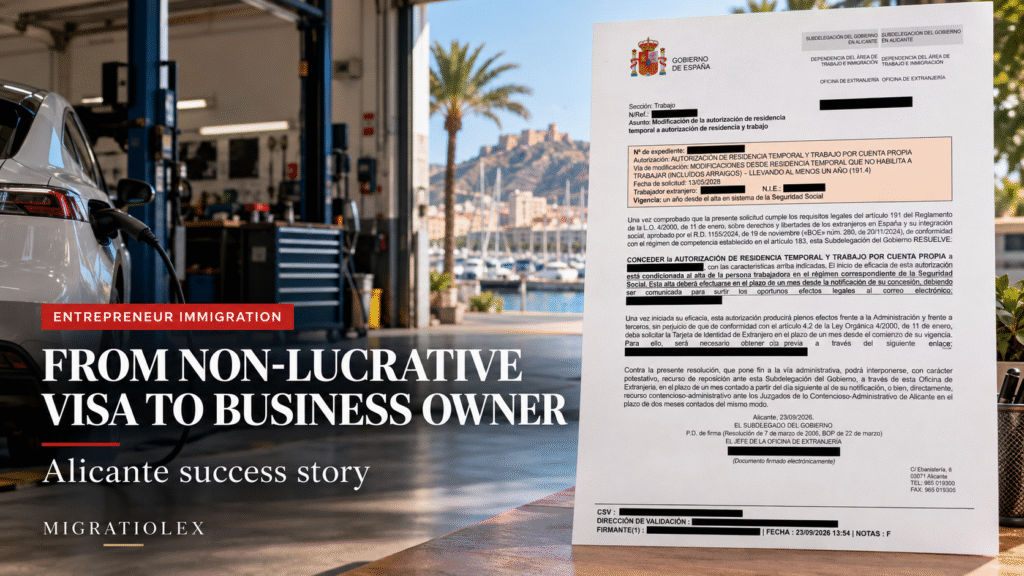
The autónomo authorisation, regulated under Real Decreto 1155/2024 (articles 82-87 of the new Reglamento de Extranjería), is built for professionals who want to work in the Spanish market, serving Spanish clients, building a local business, or freelancing without any restriction on where their income comes from.
If your clients are mostly abroad, the Digital Nomad Visa is likely your route. If you want to build a client base in Spain, the autónomo authorisation is the right framework.
Income Requirements: Two Different Standards
The Digital Nomad Visa requires proving a minimum income of 200% of the Spanish SMI, approximately €2,849 per month for a single applicant in 2026. This is verified through:
- Bank statements covering the last three to six months.
- Active contracts with your foreign clients or employer.
- Invoicing records showing a consistent, traceable income pattern.
The autónomo authorisation works differently. There is no fixed monthly figure to hit. Instead, it requires a business plan, proof of solvency, and compliance with fiscal and Social Security obligations, and the administration assesses whether your projected activity is genuinely viable without relying on public resources.

Tax: One Route Has a Clear Advantage
This is the difference that surprises most applicants. Digital Nomad Visa holders may apply for the Beckham Law (Régimen Especial de Trabajadores Desplazados, article 93 of Ley 35/2006), which allows a flat 24% income tax rate on earnings up to €600,000 per year, well below Spain’s standard progressive rates, which can reach 47%.
The autónomo authorisation does not carry Beckham Law eligibility by default. A freelancer working mainly for Spanish clients under the autónomo route pays standard IRPF rates from day one, and over five years that gap can add up to tens of thousands of euros.
One important caveat: the Beckham Law is not applied automatically. It requires a formal application (modelo 149) within six months of your residence approval. Miss that window and the benefit is lost for good.

Duration and Path to Permanent Residency
The Digital Nomad Visa is valid for one year if applied from abroad, or three years if applied from within Spain, with a two-year renewal available (five years total).
The autónomo authorisation is initially granted for one year, but it can then be renewed for an additional four years, and once renewed you can also work as an employee, with no regional or job-related restrictions.
Both routes count towards the five-year threshold for long-term residency and the path to Spanish nationality. For Ibero-American nationals, that path is especially attractive, since citizenship can be requested after just two years of legal residency.
Comparing visa types is only part of the picture. If the DNV is the better fit, start your Digital Nomad Visa application to see income thresholds, required documents and the full timeline.

Why This Decision Is Harder Than It Looks
- Treating the Digital Nomad Visa as a “better” version of the autónomo route. It is not a better version, it is a different visa for a different professional profile.
- A consultant who invoices mostly Spanish companies applies for the Digital Nomad Visa anyway: when the UGE-CE or consulate reviews the client list, the application fails and the fee is lost.
- The reverse error is just as costly: a remote professional with a foreign employer applies for the autónomo route and misses the Beckham Law window entirely, paying significantly more tax for the full residency.
- The 20% Spanish-client rule requires ongoing management. A shift in your client mix mid-residency, without adjusting your legal situation, can put you in breach without you realising it.
- Social Security obligations differ between the two routes, and if your home country has no bilateral agreement with Spain, a small administrative error early on can create compliance problems that complicate every renewal.
Not Sure Which Route Actually Fits You?
The right answer depends on where your clients are, what you earn, and what you want to build in Spain. A quick check can point you in the right direction before you commit to either file.
Check Your Eligibility in 2 Minutes →Neither route is universally better. The right choice depends on who your clients are, what you earn, what you want to build in Spain, and how you plan your taxes over the next five years. Get this decision wrong, and it is not just a paperwork delay, it is years of paying the wrong tax rate or holding the wrong visa for the business you actually run.
Talk to a Lawyer Before You File
If you are still unsure which route fits your actual professional situation, that uncertainty is exactly why a consultation exists. At MigratioLex, our lawyers assess your real client base and income structure, tell you clearly which route fits, and build the file that gives your application the best chance of approval. We respond within 24 hours, in English, French or Spanish.
Book Your Initial ConsultationThis article is for informational purposes only and does not constitute legal advice. Based on Ley 28/2022 (Startups Law), Real Decreto 1155/2024 and article 93 of Ley 35/2006 (Beckham Law).