You have built your career running a technology company from abroad, and Spain has just approved your move as an international teleworker. Then your mother asks the question you were not ready for: what happens to her, alone, back home, once you are gone?
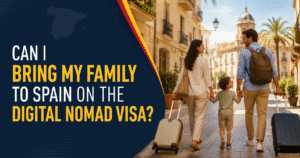
Digital Nomad Visa Dependent Parents: Not Just a Spouse and Kids
Whether you are moving as an employee, a freelancer with your own clients, or the director of your own company abroad, the Spain Digital Nomad Visa (Article 74 bis of Law 14/2013) lets you bring more than a suitcase to Spain.

Most applicants stop at spouse and minor children. Your parents, legally your ascendientes, can be included too, as long as you can show they genuinely depend on you. If you are also weighing how the rest of your family fits into the file, our guide to bringing family on the Digital Nomad Visa covers spouses and children in detail.
What Counts as “Dependence”
Spanish law recognizes three ways to prove that dependence, and you only need one.
- Age 80 or older: dependence is presumed automatically. No separate economic or medical case is required, though the file still has to be complete.
- Economic dependence (under 80): current regulation (RD 1155/2024, art. 196.3) requires transfers or expenses covered over the full year before filing, totaling at least 51% of the per capita GDP of your parent’s country of residence, using World Bank data.
- Physical dependence (under 80, below the economic threshold): a medical report or social services documentation showing your parent genuinely needs care and cannot live independently.
Example: India’s GDP per capita is around $2,700 (World Bank, 2024). Fifty-one percent of that is roughly $1,375 a year, close to €115 a month. Send less than that, and transfers alone will not be enough, however genuine the support is. The exact threshold moves with the country and the year, so check it against current World Bank data at the time you file, not a previous case.
What Documentation Your Parents Will Actually Need
Beyond proving dependence, expect to gather:
- A valid passport
- A criminal record certificate covering their recent years of residence abroad
- Apostilled documents with a certified, sworn translation into Spanish
- Proof of dependence: the 80+ presumption, a full year of bank transfer records, or medical and social services documentation
- Private or public health insurance with no copayments or waiting periods
In practice, the apostille and certified translation step is where most delays happen, because it depends on institutions you do not control and can take several weeks. Start it early.
Why This Process Is Harder Than It Looks
- Assuming a parent qualifies automatically, with no dependence evidence on file
- Relying on the 80-plus presumption alone, without the rest of the required documentation around it
- Starting financial transfers only in the months right before filing, instead of building a full year of history
- Underestimating how long apostilles and sworn translations actually take
Not Sure If Your Setup Qualifies?
A quick check can save you weeks of back and forth before you start gathering documents for your parents.
Check Your Eligibility in 2 Minutes →Talk to a Lawyer Before You File
If you are not sure whether your parents’ situation will hold up as dependents, or how to document it correctly, that uncertainty is exactly why a consultation exists. At MigratioLex, we review your specific case, not a generic checklist. We respond within 24 hours, in English, French or Spanish.
Book Your Initial ConsultationThis article is for informational purposes only and does not constitute legal advice. Based on Article 74 bis of Law 14/2013, Real Decreto 1155/2024 (art. 196) and current UGE-CE practice as of August 2026; individual cases vary and should be reviewed directly with a qualified lawyer.