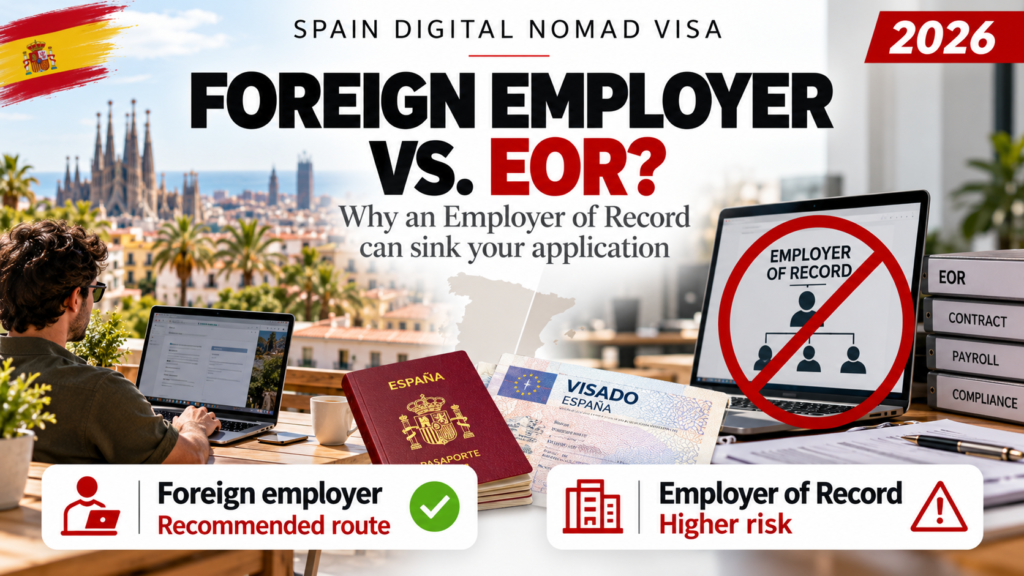
Your company is happy to let you work from Spain, and HR has a quick answer: “We’ll put you on an Employer of Record.” It sounds like the safe option, but get the digital nomad visa employer of record question wrong and that one detail can break your application.
What the Law Requires From Employees
The Digital Nomad Visa is built on one idea: you work remotely for companies located outside Spain. Article 74 bis of Law 14/2013 states that employees holding this permit may only work for companies based outside Spanish territory.
Article 74 ter adds the evidence you need as an employee:
- An employment relationship with the non-Spanish company for at least the last three months.
- A company with real and continued activity for at least one year.
- Written proof that the company allows you to work remotely.
Our complete Digital Nomad Visa guide covers every route. The rules above apply whatever your nationality; if your employer is a US company paying you on a W-2, we explain that specific case here:

Where the Digital Nomad Visa Employer of Record Problem Starts
“Employer of Record” is a commercial label, not a legal category. The same provider can play two very different roles:
- EOR as legal employer: the provider hires you directly in Spain. Your employer is now a Spanish entity, which clashes with the requirement to work for a company outside Spain.
- Provider as representative only: your foreign company remains your employer, registers in Spanish Social Security with its own contribution account code (CCC, Código de Cuenta de Cotización), and the provider handles the administration on its behalf.
There is a second immigration risk. If moving to an EOR creates a new employment relationship with a Spanish entity, you may no longer be able to show the required three months with the qualifying foreign employer.
An EOR arrangement may also raise concerns under Article 43 of the Workers’ Statute if the Spanish entity merely supplies personnel without genuinely exercising the responsibilities of an employer. Whether unlawful employee lending exists depends on the actual contractual and operational structure, not simply on the use of an EOR.
So the question is never the provider’s name. It is who legally appears as your employer and who holds the Social Security obligations.
The Safer Route: Register the Foreign Company as an Employer
For employees planning to settle in Spain for several years, we usually recommend that the foreign company registers as an employer in Spanish Social Security. This does not, by itself, require a Spanish subsidiary.
- The company obtains its employer registration and CCC in Spain.
- A local provider acts solely as its authorised administrative representative; the foreign company stays the actual employer.
- You are registered and contribute to Spanish Social Security.
- The company arranges payroll administration and, where legally required, the corresponding tax withholding and reporting.
This is not the only option. In certain cases, a valid certificate of coverage under an applicable international agreement may let you stay insured in your home country, although for employees it only works partially and must expressly cover remote work from Spain.
Whether this option exists depends on the agreement between Spain and your employer’s country. Want to know more about how to comply with Social Security in Spain? Read here how it works in one specific case, employees of Japanese companies under the Spain-Japan Social Security agreement:

Either way, employer contributions are a real cost for the company, so ask for a salary simulation before HR signs off.
The Tax Upside: Beckham Law for Digital Nomad Employees
Article 93 of the Personal Income Tax Law expressly treats employees holding the international teleworker visa as meeting the relocation condition of the Beckham Law:
- Your salary taxed at a flat 24% up to €600,000, 47% above (savings income follows its own scale).
- Applies in the year you move and the following five tax years.
- You must not have been Spanish tax resident in the previous five years.
Eligibility is not automatic. You must meet every requirement and opt in through Form 149 within six months of starting your activity in Spain, which is why the employment structure must be settled early.
Why This Process Is Harder Than It Looks
- Signing an EOR contract before checking who appears as the legal employer.
- Switching your contract right before applying and losing the three-month relationship with the foreign company.
- Treating a casual “remote work is fine” email as proof of authorisation.
- Ignoring Social Security costs until the first payroll.
- Deciding the structure so late that the Form 149 deadline is at risk.
Check Your Taxes Before You Move
Share your numbers and our team will review them and reply with a provisional, personalised answer and your next steps.
Get Your Free Tax Estimate →If Spain looks like your route, start your Digital Nomad Visa application and we will check your employment structure before anything is filed.

HR’s quick answer may still work, if the provider only acts as a representative. Make sure the setup works not only for HR, but also for Spanish immigration, employment law, Social Security and your taxes, before you sign.
Talk to a Lawyer Before You File
If you are still unsure whether your employment setup qualifies, that uncertainty is exactly why a consultation exists. At MigratioLex, we review your specific case, not a generic checklist. We respond within 24 hours, in English, French or Spanish.
Book Your Initial ConsultationThis article is for informational purposes only and does not constitute legal advice. Based on Law 14/2013 (arts. 62, 74 bis and 74 ter), Royal Legislative Decree 2/2015 (art. 43 of the Workers’ Statute) and Law 35/2006 (art. 93, as amended by Law 28/2022).